
Halal, HACCP, and BAP Certification Trends Reshaping Global Seafood Trade in 2026
August 24, 2026 — For seafood importers, a certificate on a supplier’s wall is no longer a nice-to-have. Halal, HACCP, and BAP certifications now function as customs keys, retail gatekeepers, and risk-transfer instruments rolled into one. This brief examines the 2026 certification landscape with concrete market data, regulatory deadlines, and practical steps buyers can take to protect their supply chains.
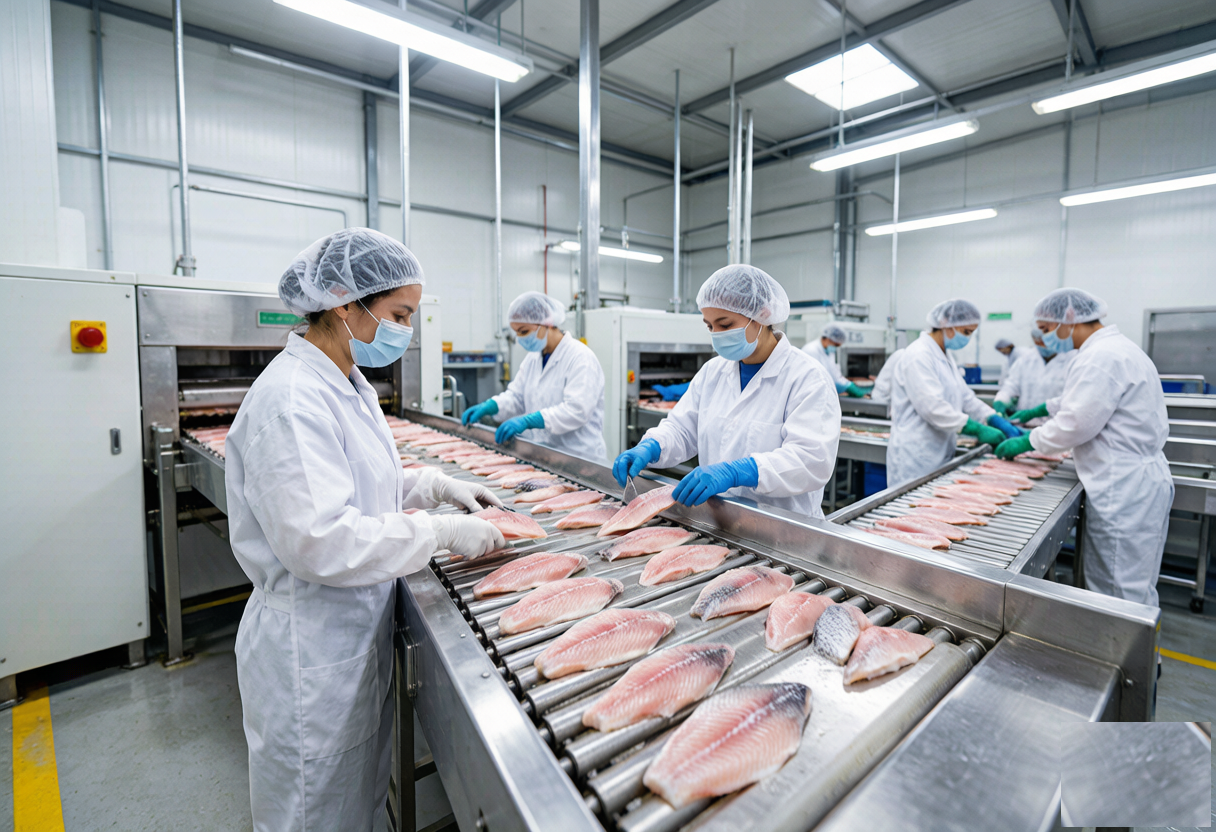
The global Halal food and beverage market was valued at approximately USD 2.45 trillion in 2025 and is projected to reach USD 3.97 trillion by 2032, growing at a CAGR of 7.15% (PW Consulting, 2026). Meat, poultry, and seafood collectively account for the largest product segment at 45.2% of total value. Behind this growth is a demographic and regulatory reality: the global Muslim population now exceeds 1.9 billion and is projected to approach 2.8 billion by 2050, while governments in Indonesia, Saudi Arabia, the UAE, and Malaysia are tightening Halal import rules. For frozen tilapia and pangasius exporters, certification is a precondition for entering the fastest-growing protein markets.
1. Halal Certification: From Religious Compliance to Trade Passport
Halal certification verifies that a food product and its production chain comply with Islamic dietary law. For seafood, this means the species is permissible, processing avoids cross-contamination with pork or alcohol-based substances, and slaughter methods meet religious requirements. The business implication extends beyond the Muslim consumer base: 71% of Muslim consumers prioritize certified Halal labeling, while 49% of non-Muslim consumers associate Halal products with higher hygiene and ingredient transparency (Research Reports World, 2026).
Global Halal food certification services were valued at USD 522 million in 2026 and are forecast to reach USD 862 million by 2034 at a CAGR of 8.8% (Stats Market Research, 2026). This growth reflects both rising demand and complexity: there is still no single global Halal standard, and exporters often need multiple country-recognized certifications to access GCC, Southeast Asian, and North African markets.
Indonesia will enforce mandatory Halal certification for food and beverages starting October 17, 2026, under BPJPH oversight (Government Regulation No. 42/2024). The country plans to issue 1.35 million free Halal certificates for micro and small enterprises during 2025–2026, signaling that even smaller processors must adapt. For seafood exporters, Indonesia’s 270 million consumers represent one of the highest-volume Halal markets — and after October 2026, uncertified products risk exclusion.
2. HACCP: The Non-Negotiable Safety Foundation
Hazard Analysis and Critical Control Points (HACCP) remains the baseline food safety system for seafood processors exporting to the United States, European Union, Japan, Australia, and the Gulf Cooperation Council (GCC). Under US FDA regulations (21 CFR Part 123), every seafood processor exporting to the US must operate a facility-specific Seafood HACCP plan identifying biological, chemical, and physical hazards and documenting controls at critical control points (CCPs). The FDA actively enforces these rules through Import Alert 16-120, which authorizes detention without physical examination for facilities with HACCP violations.
Europe has added a digital layer. Effective January 10, 2026, all fishery products entering the EU must carry digital CATCH certificates replacing paper documentation. These certificates require vessel identification, gear type, catch location, and fishing operation dates — information that must flow from harvest through processing. Importers without compliant documentation face border delays or rejection.
Recent enforcement trends confirm that HACCP is not a paperwork exercise. Multiple Chinese seafood processing facilities received FDA warning letters in early 2026 for HACCP failures, including inadequate drug residue monitoring and processing violations (SeafoodSource, 2026). For buyers, a current HACCP certificate dated within the last 12 months should be the minimum threshold for supplier qualification.
3. BAP: Sustainability as a Commercial Differentiator
Best Aquaculture Practices (BAP), administered by the Global Seafood Alliance (GSA), is the world’s most comprehensive third-party aquaculture certification program. BAP covers the entire production chain: hatcheries, feed mills, farms, and processing plants. The program is built on four pillars — environmental responsibility, social accountability, food safety, and animal health and welfare — and assigns star ratings based on how many supply-chain stages are certified.
The scale of BAP certification has expanded significantly. The program now covers more than 3,100 farm facilities, 540 processing plants, 340 hatcheries, and 150 feed mills across 39 producer countries (BAP Certification, 2026). Species covered include tilapia, pangasius, shrimp, salmon, and more than 20 additional farmed seafood categories. BAP-certified processing plants collectively produce over 1.8 million metric tons annually, and BAP seafood is sourced by more than 200 retail and foodservice companies worldwide (Global Seafood Alliance).
For whitefish buyers, the star system matters. Two-star BAP means the processing plant and associated farms are certified. Three-star adds hatchery certification. Four-star — the highest designation — means every facility in the production chain, including the feed mill, has passed annual third-party audits. This assurance is increasingly required by North American and European retail chains on ESG and traceability grounds.
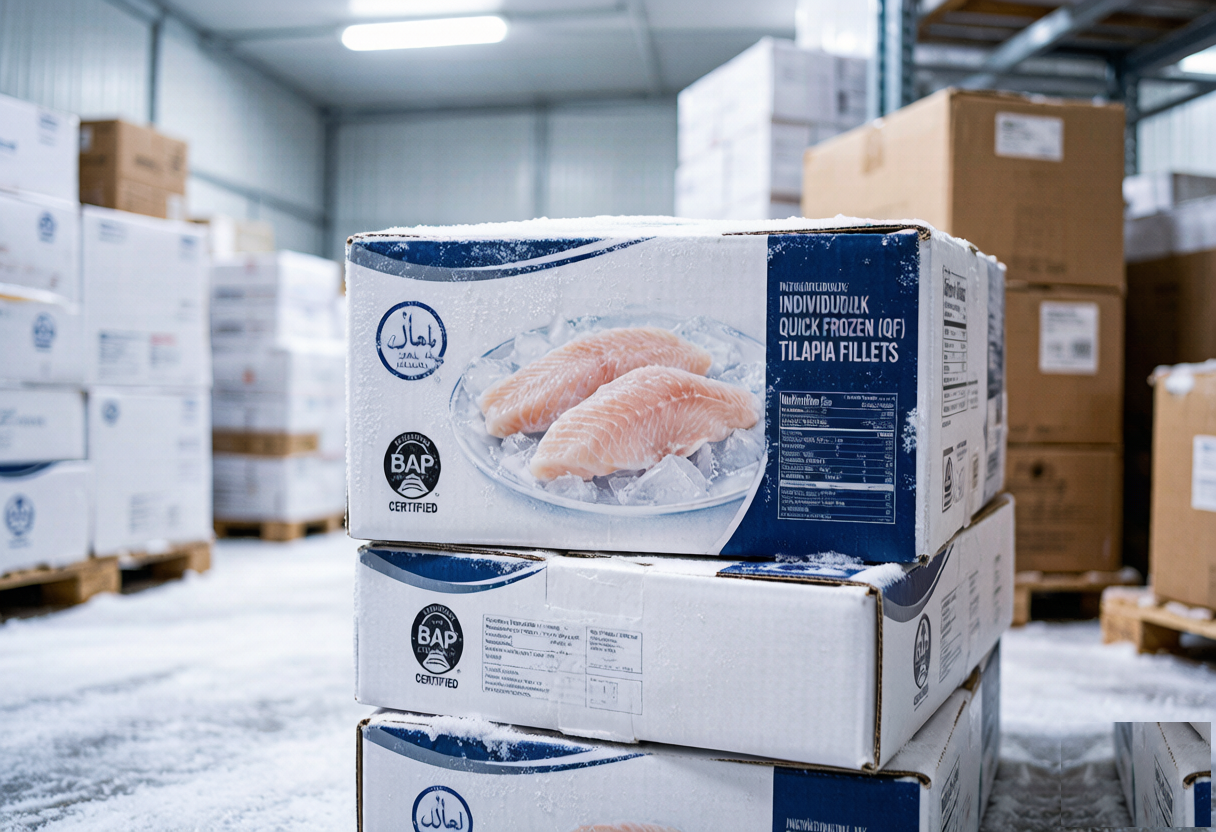
Certified frozen seafood in cold storage — Halal, HACCP, and BAP labels are becoming standard requirements for retail and foodservice buyers.
4. Certification and Market Access: The China Tilapia Example
China’s tilapia export performance in 2026 illustrates how certification underpins trade volume. In April 2026, China exported 57,010.6 metric tons of tilapia products worth USD 105 million, with an average price of USD 1.84 per kilogram (China Customs, via Blue Sea Fishery, 2026). Guangdong, Guangxi, and Hainan together contributed over 93% of national export value.
Market diversification is accelerating. Côte d’Ivoire imported 13,597.5 tons of Chinese tilapia in April 2026, surpassing the United States and Mexico to become China’s largest single overseas market for the month. West Africa as a region absorbed more than 55% of China’s whole-frozen tilapia shipments. Many of these markets — including Nigeria, Senegal, and Ghana — have substantial Muslim populations where Halal certification strengthens retail and foodservice acceptance.
In the first half of 2026, Maoming — China’s tilapia capital — exported 74,000 tonnes, up 51.8% year-on-year (Zhanjiang Customs / GACC, via Seafood Media Group). The city has implemented a collective farm registration model and a digital traceability platform called “Yu Sheng Shi” that records fingerling origin, feed, treatments, and quality analyses. This digital infrastructure is designed to meet FDA and EU requirements on drug residues, safety, and traceability — directly supporting HACCP and export certification compliance.
| Certification | Scope | Key Markets | 2026 Market Signal |
|---|---|---|---|
| Halal | Ingredient integrity, processing hygiene, no cross-contamination | Indonesia, Malaysia, GCC, North Africa, Turkey | Indonesia mandatory F&B Halal from Oct 17, 2026; USD 2.45T global Halal F&B market in 2025 |
| HACCP | Hazard analysis, CCP monitoring, corrective actions, documentation | USA, EU, Japan, Australia, GCC | FDA Import Alert 16-120 enforcement; EU digital CATCH certificates since Jan 10, 2026 |
| BAP | Farm-to-fork aquaculture: hatchery, feed mill, farm, processing plant | USA, EU, Canada, retail chains | 3,100+ farms, 540+ plants, 39 countries; >200 retail/foodservice buyers |
| BRC / ISO 22000 | Food safety management systems built on HACCP | UK, EU, Australia, premium retail | GFSI-recognized; required by major supermarket chains |
Table 1: Certification comparison for frozen seafood importers. Sources: BAP Certification (2026), PW Consulting (2026), Stats Market Research (2026), FDA/EU regulatory notices (2026).
5. What B2B Buyers Should Verify
Certification value depends on authenticity. Buyers should verify the following before placing orders:
- Certificate validity: Confirm HACCP, Halal, and BAP certificates are current and dated within the last 12 months. Verify numbers with the issuing body where possible.
- Scope match: Ensure the certificate covers the specific product — frozen tilapia whole fish, tilapia fillet, or pangasius fillet — and the production facility, not just the company headquarters.
- Traceability records: Ask for lot-level documentation linking raw material origin, processing date, freezing method, and cold-chain temperature logs. This is essential for EU CATCH and FDA compliance.
- Third-party audit history: Request recent audit reports or summaries. Major non-conformities should be closed with documented corrective actions.
- Cross-contamination controls: For Halal products, verify that processing lines, storage areas, and transport containers are segregated from non-Halal items, particularly pork and alcohol-based cleaning agents.
- Country-specific approvals: Confirm the supplier holds EU establishment numbers, FDA registration, or other national approvals required for the destination market.
6. NEGUPGROUP Certified Frozen Seafood Program
NEGUPGROUP’s frozen seafood program is structured around HACCP-certified partner plants in southern China’s tilapia and pangasius clusters, with Halal and BAP certification available on request for retail, foodservice, and institutional buyers. The product line reflects the industry-standard grades that global importers demand:
| Product | Size / Grade | Packaging | Freezing |
|---|---|---|---|
| Frozen Tilapia Whole Fish | 300–500g / 500–800g / 800g+ | 10 kg/carton | Block frozen |
| Frozen Tilapia Fillet — skin-on | 3–5 oz / 5–7 oz | 10 kg/carton | IQF |
| Frozen Tilapia Fillet — skinless | 3–5 oz / 5–7 oz | 10 kg/carton | IQF |
| Frozen Pangasius Fillet — well-trimmed | 3–5 oz | 10 kg/carton | IQF |
Table 2: NEGUPGROUP core frozen tilapia & pangasius specifications. MOQ: 1 × 40 ft reefer container. HACCP / Halal / BAP certified lines available; 5 kg/carton and private-label packs on request; samples within 7 working days.
Reefer containers at port — the final link in the certified cold chain from processor to importer.
Downloadable Resource: Halal, HACCP & BAP Certification Brief (PDF)
Download PDF — Halal, HACCP & BAP Certification Guide for Seafood Importers
Includes: certification comparison table, buyer verification checklist, regulatory deadline summary, and full NEGUPGROUP product specification sheet.
7. The Bottom Line
Halal, HACCP, and BAP certifications are converging from separate compliance boxes into a unified market-access requirement. The Halal market alone is approaching USD 4 trillion by 2032. Indonesia’s October 2026 mandatory Halal deadline will force a new wave of supplier qualification. HACCP enforcement by the FDA and the EU’s digital CATCH certificate system are raising the documentation bar. BAP certification, backed by more than 4,000 certified facilities worldwide, is becoming a retail prerequisite in North America and Europe.
For importers, the practical response is to treat certification as a sourcing filter rather than an afterthought. Suppliers with current HACCP, Halal, and BAP credentials, supported by digital traceability and third-party audit records, deliver lower customs risk, faster clearance, and stronger retail acceptance. NEGUPGROUP’s certified frozen tilapia and pangasius program is structured to meet these requirements at container scale, with documentation, samples, and private-label support available on request.
Inquiry Tags
Halal Tilapia
HACCP Certified Seafood
BAP Certified Pangasius
Frozen Tilapia Fillet
Seafood Certification Documents
Next Steps
- Request Quotation — Get container-level pricing for Halal, HACCP, or BAP-certified frozen tilapia and pangasius.
- Ask for Samples — Receive certified product samples within 7 working days for quality and label verification.
- Check Product Specifications — Download the full certification and product spec sheet (PDF above).
- Contact NEGUPGROUP Seafood Team — WhatsApp +86 13360658417 or email [email protected] for certification questions, audit schedules, or market-specific documentation.