
IQF Freezing Technology and Cold-Chain Quality Control in Frozen Seafood: A 2026 Technical Brief for B2B Buyers
August 24, 2026 — For B2B seafood importers, the difference between a profitable container and a rejected shipment often comes down to what happens in the 30 minutes after a fish leaves the processing line. This brief explains the science behind IQF freezing, the cold-chain discipline that protects product integrity from plant to port, and what buyers should look for when auditing a frozen seafood supplier.
The global IQF (Individually Quick Frozen) seafood market was valued at approximately USD 9.9–14.5 billion in 2025 and is projected to reach USD 17.1–23.1 billion by 2032–2033, growing at a CAGR of 6.7–7.1% (Future Market Report; PW Consulting; Report Prime). Asia Pacific commands the largest regional share at 38.4–38.6%, with China alone holding a 22.7% market share and hosting over 60% of global shrimp and fish IQF processing capacity (Dataintelo; Future Market Report). For importers of frozen tilapia fillets, pangasius, and other whitefish products, understanding how IQF technology works — and how to verify that a supplier’s cold chain actually preserves it — is no longer optional. It is a procurement necessity.
1. What IQF Actually Does: The Science of Ice Crystals
The fundamental principle of IQF is speed. When seafood is frozen slowly — as in a conventional blast freezer operating at -35°C with 2–8 hour cycle times — water molecules inside the tissue migrate and aggregate into large ice crystals. These crystals puncture cell membranes. Upon thawing, the damaged cells release their liquid as “drip loss,” resulting in a product that is drier, tougher, and lighter than what was frozen. Traditional freezing methods can cause dehydration losses of 10–15% by weight (Tradefrat, 2026).
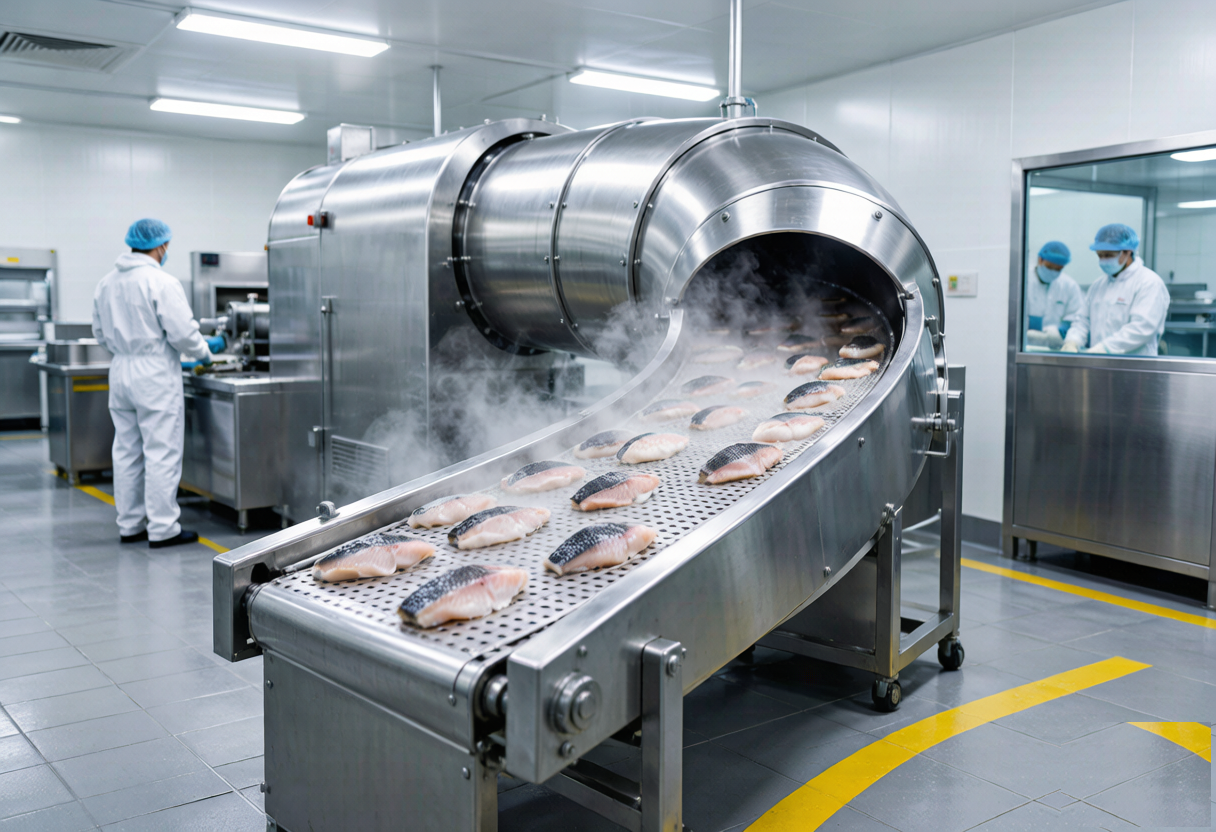
IQF technology reverses this by passing each piece of seafood through a freezing tunnel — spiral, straight-belt, or fluidized bed — where air at -35°C to -40°C freezes each piece individually in 10–30 minutes, depending on product size. The rapid transit through the “maximum ice crystal formation zone” (-1°C to -5°C) produces micro-crystals that are too small to rupture cell walls. The result: moisture, texture, flavor, and nutritional value are locked in, and drip loss upon thawing is sharply reduced (Kantaphat Seafood; Tradefrat, 2026).
For B2B buyers, the commercial implication is direct: IQF fillets yield more sellable weight per kilogram than block-frozen equivalents, and they present better in retail and foodservice settings where individual portioning matters.
| Parameter | IQF Freezing | Blast / Block Freezing | Source |
|---|---|---|---|
| Freezing air temperature | -35°C to -40°C | -35°C to -45°C | Kantaphat Seafood, 2026 |
| Freezing time per batch | 10–30 minutes | 2–8 hours | Kantaphat Seafood, 2026 |
| Ice crystal size | Micro (sub-cellular) | Large (membrane-piercing) | Tradefrat, 2026 |
| Typical dehydration loss | <2–3% | 10–15% | Tradefrat, 2026 |
| Throughput capacity | Up to 10,000 kg/h | Batch-dependent | Tradefrat, 2026 |
| Portionability | Individual, free-flowing | Must thaw entire block | Kantaphat Seafood, 2026 |
| Best for | Fillets, shrimp, scallops (retail/foodservice) | Whole fish, large fillets (industrial reprocessing) | Industry standard |
Table 1: IQF vs. blast/block freezing comparison. Sources: Kantaphat Seafood (2026); Tradefrat (2026).
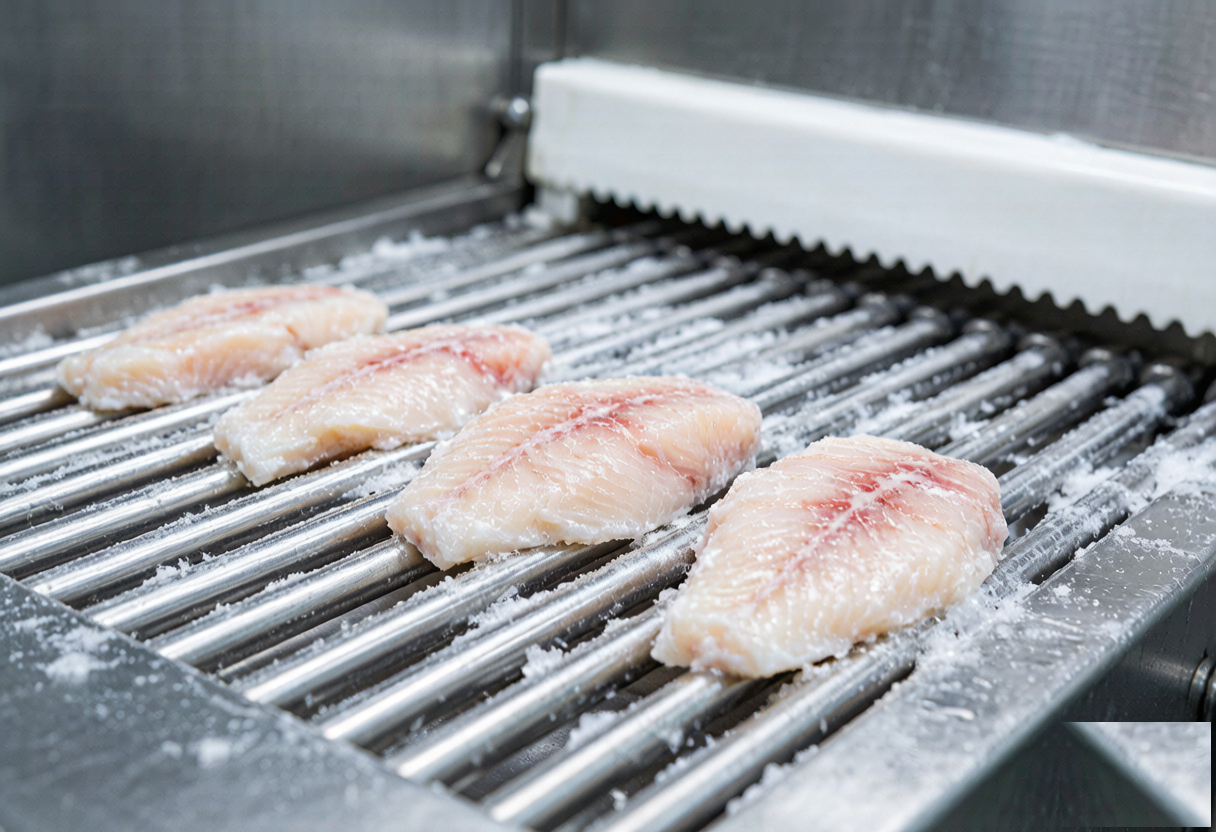
IQF tilapia fillets exiting a spiral freezer tunnel — each piece frozen individually, free-flowing, with minimal drip loss upon thawing.
2. The Cold Chain: From Freezer to Reefer Container
Freezing is only the first step. The cold chain — the unbroken series of temperature-controlled storage and distribution activities — determines whether the quality locked in during IQF freezing actually reaches the buyer. The core rule is simple: frozen seafood must be maintained at -18°C (0°F) or below at every stage, from cold storage through loading, transport, and delivery (Kantaphat Seafood, 2026).
Any temperature excursion above -18°C triggers a cascade of quality and safety risks:
- Texture degradation: Ice recrystallization during temperature cycling creates progressively larger crystals, causing the same cell damage that IQF was designed to prevent.
- Freezer burn: Surface dehydration from temperature fluctuations causes ice sublimation, creating dry, discolored patches.
- Microbial risk: Pathogens can resume growth above -10°C and multiply rapidly above 0°C.
- Shelf life reduction: A product rated for 24 months at -18°C may last only 6–12 months if it experiences thermal abuse (Kantaphat Seafood, 2026).
The most critical vulnerability in the cold chain is the transfer from cold storage to the reefer container. Best practices include pre-cooling the container to -18°C before loading, minimizing dock exposure time to under 2–4 hours, recording product and container temperatures at start and end of loading, and stacking cartons to allow air circulation through the T-bar floor channels without blocking airflow (Kantaphat Seafood, 2026).
3. HACCP Compliance and Equipment Hygiene
Modern IQF freezers are engineered to meet HACCP (Hazard Analysis and Critical Control Points) principles. Key design features include:
- SUS304/316L stainless steel construction with fully welded, sloped bases for effective drainage — eliminating sanitary dead corners where bacteria can accumulate.
- CIP (Clean-in-Place) systems that automatically clean and disinfect conveyor belts and interior chambers, reducing manual cleaning downtime and cross-contamination risk.
- PLC (Programmable Logic Controller) touch screens enabling real-time adjustment of conveyor speed and freezing temperature by product type — tilapia fillets, shrimp, and pangasius each have different optimal freezing parameters.
- Fault self-diagnosis with real-time monitoring and automated alarms, supporting the process documentation and traceability records required by HACCP audits and certifications such as BAP, Halal, and GFSI (Delicious-Cooks, 2026; Tradefrat, 2026).
For importers, these features translate into audit-ready compliance. A processor with a modern IQF line, PLC data logging, and CIP cleaning can produce the digital records that customs authorities and certification bodies increasingly demand — reducing clearance delays and protecting the buyer’s supply continuity.
4. AI-Powered Inspection: The Next Frontier
In 2026, a growing number of IQF facilities are deploying AI-powered inspection systems that use machine learning, computer vision, and spectroscopic sensors to detect contaminants and quality defects at line speed. These systems address challenges that have long plagued IQF production:
- Foreign material detection: AI models can identify stones, shell fragments, plastic, and other contaminants that traditional optical sorters miss — critical for fillet lines where shell fragments from de-heading can enter the product stream (KPM Analytics, 2026).
- Quality grading: AI assesses color, size, shape, and surface defects in real time, making grading decisions that are more consistent than subjective human inspection at high throughput.
- Data-driven traceability: Every inspection event generates a digital record, providing the audit trails required by FSMA, HACCP, and GFSI certification bodies.
The ROI case is compelling: the average food recall costs a company upward of USD 10 million in lost product, penalties, brand damage, and liability. AI inspection reduces both false positives (good product rejected) and false negatives (defective product passed), cutting waste and recall risk simultaneously (KPM Analytics, 2026).
5. Global IQF Seafood Market: Sizing and Regional Dynamics
The IQF seafood market exhibits strong growth across all major research firms’ forecasts, though absolute size estimates vary by methodology and scope:
| Source | 2025 Value | Forecast Value | Forecast Year | CAGR |
|---|---|---|---|---|
| Dataintelo | $31.4B | $52.8B | 2034 | 5.9% |
| PW Consulting | $14.5B | $23.1B | 2032 | 6.85% |
| Future Market Report | $9.9B | $17.1B | 2033 | 7.07% |
| Report Prime | $7.2B | $12.1B | 2032 | 6.70% |
Table 2: Global IQF seafood market size forecasts by research firm. Variance reflects different scope definitions (some include crustaceans and prepared meals; others focus on raw seafood). Sources: Dataintelo, PW Consulting, Future Market Report, Report Prime (all 2026 reports).
Regardless of which estimate one uses, the directional signal is consistent: IQF seafood is a high-growth segment expanding faster than the overall frozen food market. Asia Pacific dominates with 38.4–38.6% of global revenue, growing at 6.8% CAGR — the fastest of any region. China’s position as the largest single-country IQF processing hub (22.7% global share, hosting over 60% of global shrimp and fish IQF capacity) makes it the strategic sourcing origin for importers who need scale, certification, and cost efficiency simultaneously (Dataintelo; Future Market Report, 2026).
6. What B2B Buyers Should Audit
When evaluating a frozen seafood supplier’s IQF and cold-chain capability, importers should verify the following:
- IQF tunnel specifications: Confirm the tunnel operates at -35°C to -40°C with 10–30 minute residence time. Ask for PLC temperature logs from a recent production batch.
- Cold storage temperature: Verify storage is maintained at -18°C or below (quality-focused processors target -20°C to -25°C for safety margin). Request continuous monitoring records with alarm thresholds.
- Loading protocols: Confirm the reefer container is pre-cooled before loading, loading time is under 4 hours, and product/container temperatures are recorded at start and end.
- Certification chain: HACCP is the baseline. For premium markets, verify BAP (Best Aquaculture Practices), Halal, and where required, GFSI-recognized certifications (SQF, BRC, IFS).
- Traceability system: Digital traceability — recording fingerling origin, feed, treatments, processing date, and cold-chain temperature logs — reduces customs clearance time by 80% or more, as demonstrated by Maoming’s “Yu Sheng Shi” system in southern China.
- AI inspection (if applicable): Ask whether the facility uses AI-powered optical inspection for foreign material and quality grading. This is an emerging differentiator that signals a processor investing in next-generation food safety.
Reefer containers being loaded at port — the final cold-chain link from processor to importer.
7. NEGUPGROUP’s IQF and Cold-Chain Capability
NEGUPGROUP’s frozen seafood program is built around IQF and block-frozen processing capacity in HACCP-certified partner plants across southern China’s tilapia and pangasius farm clusters. The product line covers the full spectrum of industry-standard grades:
| Product | Size / Grade | Packaging | Freezing |
|---|---|---|---|
| Frozen Tilapia Whole Round | 300–500g / 500–800g / 800g+ | 10 kg/carton | Block frozen |
| Frozen Tilapia Gutted (2-cut / Dressed) | 300–500g / 500–800g / 800g+ | 10 kg/carton | Block frozen |
| Frozen Tilapia Fillet — skin-on | 3–5 oz / 5–7 oz | 10 kg/carton | IQF |
| Frozen Tilapia Fillet — skinless | 3–5 oz / 5–7 oz | 10 kg/carton | IQF |
| Frozen Pangasius Fillet — well-trimmed | 3–5 oz | 10 kg/carton | IQF |
Table 3: NEGUPGROUP core frozen tilapia & pangasius specifications. MOQ: 1 × 40 ft reefer container (approx. 26–27 MT). HACCP / Halal / BAP certified lines; samples within 7 working days; 5 kg/carton and private-label retail packs available on request.
Downloadable Resource: IQF & Cold-Chain Technical Brief (PDF)
Download PDF — IQF Technology & Cold-Chain Quality Control Brief
Includes: IQF vs. blast freezing comparison, cold-chain temperature checkpoints, HACCP compliance checklist, and full NEGUPGROUP product specification sheet.
8. The Bottom Line
IQF technology is not a marketing label — it is a measurable quality differentiator backed by physics. Micro ice crystals preserve cell structure, reduce drip loss, and deliver more sellable weight per kilogram. But IQF quality only holds if the cold chain is unbroken from tunnel to reefer, and if the processor maintains the HACCP discipline, digital traceability, and certification chain that protect the buyer’s clearance and reputation. Importers who audit these capabilities — not just the price quote — will consistently land better product and fewer claims. NEGUPGROUP’s IQF and block-frozen program is built to pass that audit, with HACCP/Halal/BAP-certified lines, full cold-chain documentation, and container-level supply readiness.
Inquiry Tags
IQF Tilapia Fillet
Frozen Pangasius Fillet
Cold Chain Documentation
HACCP Certified Seafood
IQF Freezing Technology
Next Steps
- Request Quotation — Get container-level pricing for IQF tilapia fillets, pangasius, or whole round tilapia.
- Ask for Samples — Receive product samples within 7 working days to evaluate IQF quality firsthand.
- Check Product Specifications — Download the full spec sheet (PDF above) for grade, packaging, and certification details.
- Contact NEGUPGROUP Seafood Team — WhatsApp +86 13360658417 or email [email protected] for technical questions, audit schedules, or cold-chain documentation requests.