
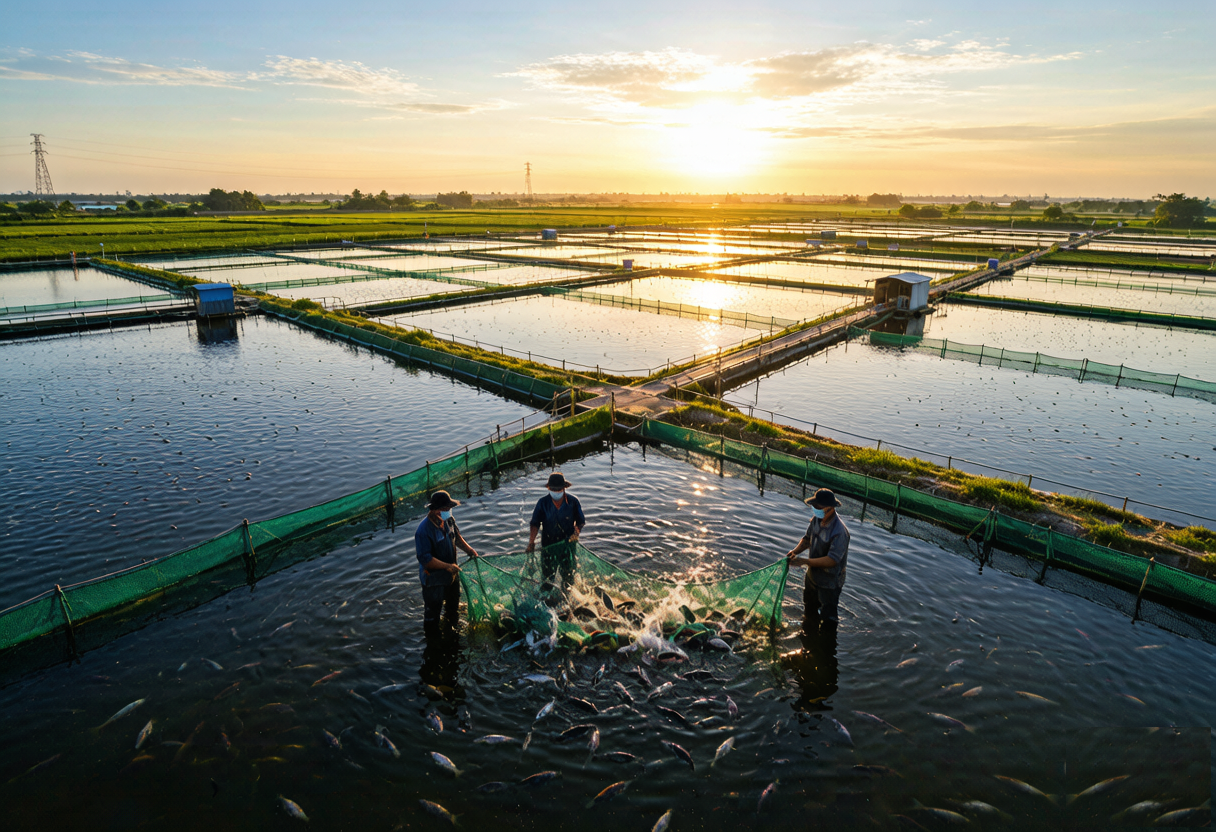
For roughly a year, frozen tilapia buyers operated in a buyer’s market: abundant Chinese supply, soft farm-gate prices and cautious downstream ordering kept offers historically low. That cycle is now visibly turning. In week 33 of 2026 (August 10–16), raw tilapia prices in Guangdong and Guangxi rose again by CNY 0.20/kg (about USD 0.03/kg) for both 300–500 g and 500–800 g fish delivered to processing plants, extending a multi-week climb driven by one simple fact: there are fewer market-size fish in the ponds than the market expected.
This brief consolidates the most recent official and trade data — China’s national tilapia supply-and-demand outlook, customs statistics from Zhanjiang, VASEP export figures and regional price surveys — and translates them into concrete sourcing actions for importers of frozen whole tilapia, tilapia fillets and pangasius fillets in the second half of 2026.
1. The Price Reversal Is Underway
According to weekly industry price surveys, the current rally is structural rather than speculative. Through late 2025 and the first half of 2026, persistently low wholesale prices — the national average hovered near CNY 16,720 per tonne (approx. USD 2,340/t) — discouraged farmers from stocking. Seedling input fell across Guangdong, and the effects have now reached harvest size. Processors in Hainan report the sharpest shortage: the traditional cross-regional flow of Hainan fish into Guangdong has stopped entirely, intensifying competition for local raw material.
“Current raw material prices are no longer sufficient to support profitable operation of processing plants — fillet prices will have to be adjusted.” — Guangdong export processor, quoted in week 33 2026 industry surveys.
Two second-order signals matter for importers. First, rising farm-gate prices are already being passed into fillet offers; buyers negotiating Q4 contracts should expect re-quoted prices rather than extensions of H1 levels. Second, the price recovery has triggered a strong rebound in stocking rates — the first clear confidence signal from farmers this year — but fish stocked today will not reach 300–500 g or 500–800 g harvest grades for several months. Tight raw-material supply is therefore unlikely to be fundamentally reversed before late 2026 at the earliest.
2. Official Data Confirms a Halving of Buffer Stocks
China’s national tilapia supply-and-demand report, released by fisheries authorities in March 2026, frames the picture. Total production is projected at 2.048 million tonnes in 2026, down 2.9% from 2.11 million tonnes in 2025, while exports expand from 1.10 to 1.148 million tonnes — lifting the export share of production from 56.7% to 63.0%. The most consequential line for buyers is ending stock: projected to fall from 208,400 tonnes in 2025 to 106,400 tonnes in 2026, a 48.9% drawdown of the buffer that previously capped price increases.
| Indicator | 2025 (est.) | 2026 (proj.) | Change | Source |
|---|---|---|---|---|
| Total tilapia production | 2,109,700 t | 2,048,300 t | −2.9% | China fisheries authorities, Mar 2026 |
| Exports | 1,100,000 t | 1,148,300 t | +4.4% | China fisheries authorities |
| Export share of production | 56.74% | 63.01% | +6.3 pp | China fisheries authorities |
| Ending stocks | 208,400 t | 106,400 t | −48.9% | China fisheries authorities |
| Maoming exports (H1) | 48,700 t | 74,000 t | +51.8% | Zhanjiang Customs / GACC, Aug 2026 |
| Average wholesale price | ~CNY 16,720/t | rising since Jul 2026 | ↗ | Industry weekly price surveys |
3. The Export Engine Keeps Accelerating
Despite the tighter domestic balance, China’s export platform is running harder than ever. Maoming — the internationally recognized “tilapia capital of China” — shipped 74,000 tonnes in the first half of 2026, up 51.8% year-on-year, with Q1 export value of about CNY 517 million (USD 72 million), up 51.1%, according to Zhanjiang Customs and the General Administration of Customs. The cluster now supplies more than 70 countries and territories, with growing momentum into Mexico, Canada, the EU, Russia, the Andean Community, Africa and Southeast Asia — deliberately reducing single-market dependence.
Buyers should also note the modernization of the compliance chain. Maoming’s collective farm-registration model and the digital “Yu Sheng Shi” traceability system record fingerling origin, feed, treatments and quality analyses in real time, and have cut customs document processing time by more than 80%. Sourcing from plants integrated into digitized traceability materially reduces clearance risk on frozen consignments.
4. The Global Demand Map Is Reshaping
The global tilapia market was valued at USD 9.2–10.59 billion in 2025, with projections toward USD 11.7–14.46 billion by 2033–34 (CAGR 2.7–3.5%) and industry forecasts of global demand reaching USD 20 billion by 2030. Under the surface, trade flows are redistributing quickly:
United States. Importers spent H1 2026 destocking: January–February frozen fillet imports from China were the lowest for the period since 2012, and week-15 wholesale prices slipped about USD 0.05/lb on inventory overhang. Washington’s 24 July 2026 Section 301 actions added a further 12.5% tariff on Chinese-origin goods, on top of an already ~40% total burden — pushing China-US flows toward other destinations and opening space for cost-competitive suppliers into Latin America.
Vietnam as a rising origin. Vietnamese tilapia exports reached USD 99 million in 2025 (+141%) and USD 35 million in Q1 2026 (+190%), with explosive growth into the Middle East, the Dominican Republic, the Netherlands, ASEAN and Brazil — evidence that buyers are actively building second origins for whitefish programs.
EU and premium Asia. Rising cod prices are moving European buyers toward tilapia fillets as a credible whitefish alternative, while Vietnamese fillet exports to Japan reached USD 1.4 million in H1 2026 (+54%), two-thirds of it fillets entering the sushi and sashimi segment — a benchmark signal for quality standards.
5. Sourcing Actions for H2 2026
For importers, the practical playbook is straightforward. Lock H2 2026 and Q1 2027 volumes at current levels before re-pricing consolidates; ending stocks at 106,400 tonnes give sellers progressively less reason to discount. Diversify destination corridors where tariffs allow — Mexico, Canada, the EU, the Middle East and Africa remain efficient routes for Chinese-origin product. Insist on digitized traceability and certification (HACCP, Halal, BAP) to protect clearance speed. And structure contracts with transparent raw-material indexation so both sides absorb the cycle rationally.
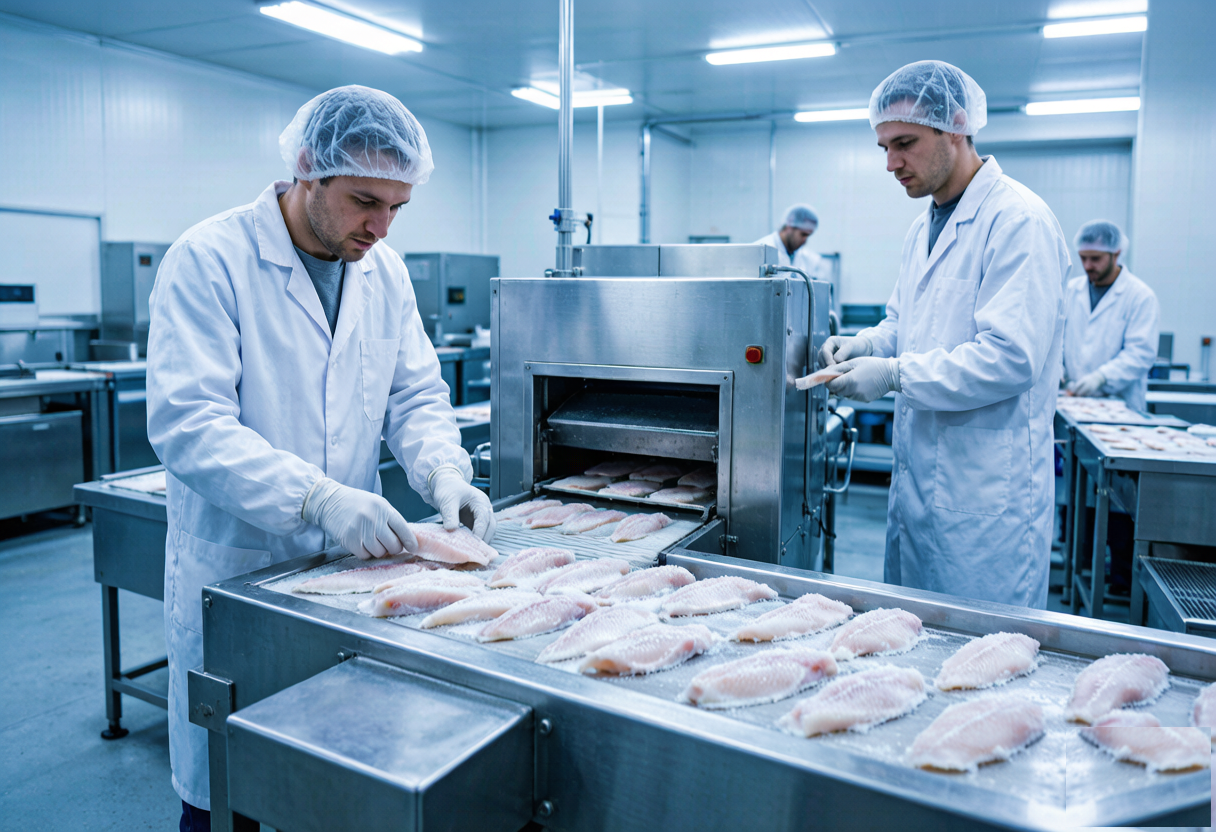
NEGUPGROUP’s frozen tilapia and pangasius program is built for exactly this phase of the cycle, with long-term raw-material agreements across southern-China farm clusters, IQF and block-frozen capacity, and export-grade specifications aligned to the industry’s standard grades:
| Product | Industry Size / Grade | Packaging | Freezing |
|---|---|---|---|
| Frozen Tilapia Whole Round | 300–500 g / 500–800 g / 800 g up | 10 kg/carton | Block frozen |
| Frozen Tilapia Gutted (2-cut / Dressed) | 300–500 g / 500–800 g / 800 g up | 10 kg/carton | Block frozen |
| Frozen Tilapia Fillet — skin-on | 3–5 oz / 5–7 oz | 10 kg/carton | IQF |
| Frozen Tilapia Fillet — skinless | 3–5 oz / 5–7 oz | 10 kg/carton | IQF |
| Frozen Pangasius Fillet — well-trimmed | 3–5 oz | 10 kg/carton | IQF |
6. The Bottom Line
Tilapia in 2026 is transitioning from an oversupplied buyer’s market into a rebalanced one. Production is down modestly, but stocks are halving, exports are growing, raw-material prices are rising for the first time in a year, and demand is diversifying across more than 70 destination markets. Importers who move early — with certified, traceable, specification-locked supply — will enter 2027 with stable programs and predictable landed costs. NEGUPGROUP’s seafood team supports buyers with grade-accurate offers, container-level MOQs, rapid sampling and full cold-chain documentation from plant to port.
Frozen Tilapia Whole Fish
Frozen Tilapia Fillet
IQF Tilapia
Frozen Pangasius Fillet
Tilapia Price 2026
Secure Your H2 2026 Tilapia Program Before Prices Re-Set
Request a quotation, ask for samples, or check full product specifications — the NEGUPGROUP Seafood Team responds within one business day with grade-accurate offers and container planning.
Request Quotation
Ask for Samples
Check Product Specifications
Contact NEGUPGROUP Seafood Team